


Revenue Teams: Book Meetings in Minutes with AI Lead Qualification
AI lead qualification automatically scores incoming leads, extracts intent from their answers, and routes the strongest prospects to sales in real time, often booking the meeting before a rep ever picks up the phone. The two gains that matter most to revenue teams are speed-to-lead and prioritized outreach: your best leads get contacted in minutes instead of hours, and your reps spend their time on the people most likely to buy. Below, we walk through how these systems work, which frameworks they model, and how to roll one out without breaking what already works.
TL;DR:
Speed-to-lead is critical, and AI systems can respond within seconds by pulling signals from forms, email, web behavior, and ad data.
Effective AI qualification tools provide real-time responses, dynamic follow-up questions, confidence scoring, auto-booking, and accurate source attribution.
Successful deployment requires auditing data, setting thresholds, testing with real leads, and gradually expanding while maintaining human oversight.
Integration with CRM and calendar tools is essential for seamless qualification, booking, and visibility into lead origin and status.
The greatest benefits are seen by high-volume, fast-decision industries like real estate, contractors, and therapy, where instant contact significantly boosts conversion.
Astreauxcalendly.comTurn New Leads Into MeetingsAstreaux learns your business voice, responds instantly to new leads, and helps service teams streamline scheduling and lead nurturing.Book a call
How AI lead qualification works under the hood
At its core, AI lead qualification pulls signals from every channel a prospect touches, scores those signals against a model, and decides what happens next, whether that is a follow-up question, a calendar invite, or a handoff to a human rep.
The inputs typically include:
Form and chat submissions, where natural language processing extracts budget, timeline, and need directly from a prospect’s own words.
Email replies and call transcripts, parsed for intent phrases and objections.
Web behavior, like page visits, pricing page views, and return sessions.
Ad platform signals, including which campaign or keyword brought the lead in.
A rules engine then layers business logic on top of the predictive score, assigning confidence levels and triggering actions, such as booking a meeting, tagging a CRM field, or escalating to a rep.
What to look for in an AI lead qualification system
Not every tool does this well, and the differences show up fast once you are live. A few capabilities separate the systems that actually move pipeline from the ones that just add another dashboard.
Real-time response and capture, so a lead’s first message gets a reply in seconds, not the next business day.
Dynamic qualification flows that adjust follow-up questions based on what the prospect just said, rather than a static script.
Scoring outputs with confidence metadata, so reps can see not just a score but how sure the model is.
Auto-booking and calendar syncing with a clean handoff to a human when a lead is ready.
CRM field writes and source attribution, so marketing and sales can see exactly where a qualified lead came from.
Pro Tip: Ask any vendor to show you a live confidence score on a sample lead before you buy, not just a final qualified or unqualified label.
Mapping BANT, MEDDIC, and SPICED into an AI model
Most qualification frameworks were built for human conversations, and the job with AI is translating their fields into signals a model can score.
BANT (Budget, Authority, Need, Timeline) maps cleanly to form fields and direct questions an AI agent can ask up front.
MEDDIC (Metrics, Economic Buyer, Decision Criteria, Decision Process, Identify Pain, Champion) needs richer conversational extraction, since fields like “champion” or “decision process” usually surface only in free text.
SPICED (Situation, Pain, Impact, Critical Event, Decision) works well for agents trained to ask situational follow-ups rather than checkbox questions.
In practice, teams combine a machine-learned fit and intent score with rule-based disqualifiers (wrong company size, out of service area) to cut false positives. A conversation extract like “we need this live before our Q1 renewal” maps directly to MEDDIC’s Critical Event field, and a good agent tags it automatically rather than waiting for a rep to notice.
Step-by-step: rolling out AI lead qualification
A pilot works best when you resist the urge to automate everything at once.
Audit your data. Pull historic won and lost deals alongside the behavioral events (page visits, form fields, reply timing) tied to each.
Define your qualification schema. Decide which fields matter (budget range, timeline, decision authority) and set acceptance thresholds for each.
Prepare training and validation data. Hold back a sample of real leads to test the model against known outcomes before going live.
Set conservative pilot settings. Start with a higher confidence threshold for auto-booking and route anything uncertain to a human.
Design human-in-the-loop checkpoints. Have a rep review a sample of AI-qualified leads weekly during the first month.
Measure, retrain, and expand. Once qualification accuracy holds steady, add channels and loosen thresholds gradually.
Governance matters here too: confirm how long lead data is stored and who can access transcripts before you turn anything on.
Pro Tip: Run your pilot on one lead source, like a single ad campaign or landing page, so you can isolate what the AI actually changed.
Integration patterns and sample workflows
The real value of AI qualification shows up in how cleanly it connects to the tools your team already uses, including common use cases in Managed AI Visibility. Our practical playbook for AI lead scoring covers scoring inputs in more depth, and a step-by-step CRM integration guide walks through writing qualification fields back into your system of record.
CRM writebacks keep scores, source attribution, and qualification notes visible to every rep without manual entry.
Calendar syncing lets a qualified lead book directly onto a rep’s open slots, cutting the back-and-forth of scheduling emails.
Priority queues with SLA timers flag high-score leads for contact within a set window and escalate automatically if that window passes.
Chat-to-booking workflows take a website visitor from first message to confirmed meeting without a human touch until the call itself.
Review platforms like G2’s Hockeystack reviews consistently point to integration reliability and data quality as the deciding factors in whether these workflows hold up past the pilot stage.
Benefits, measurement, and the limits worth knowing
The clearest, most researched benefit of automation here is speed. Harvard Business Review’s analysis of online sales leads found that delays in contacting a lead substantially reduce the odds of converting it, which is exactly the gap AI qualification closes by responding the moment a lead arrives.
Speed-to-lead is the KPI that moves everything else: faster first contact tends to lift both qualification rate and booking rate, and it is the easiest number to track from day one.
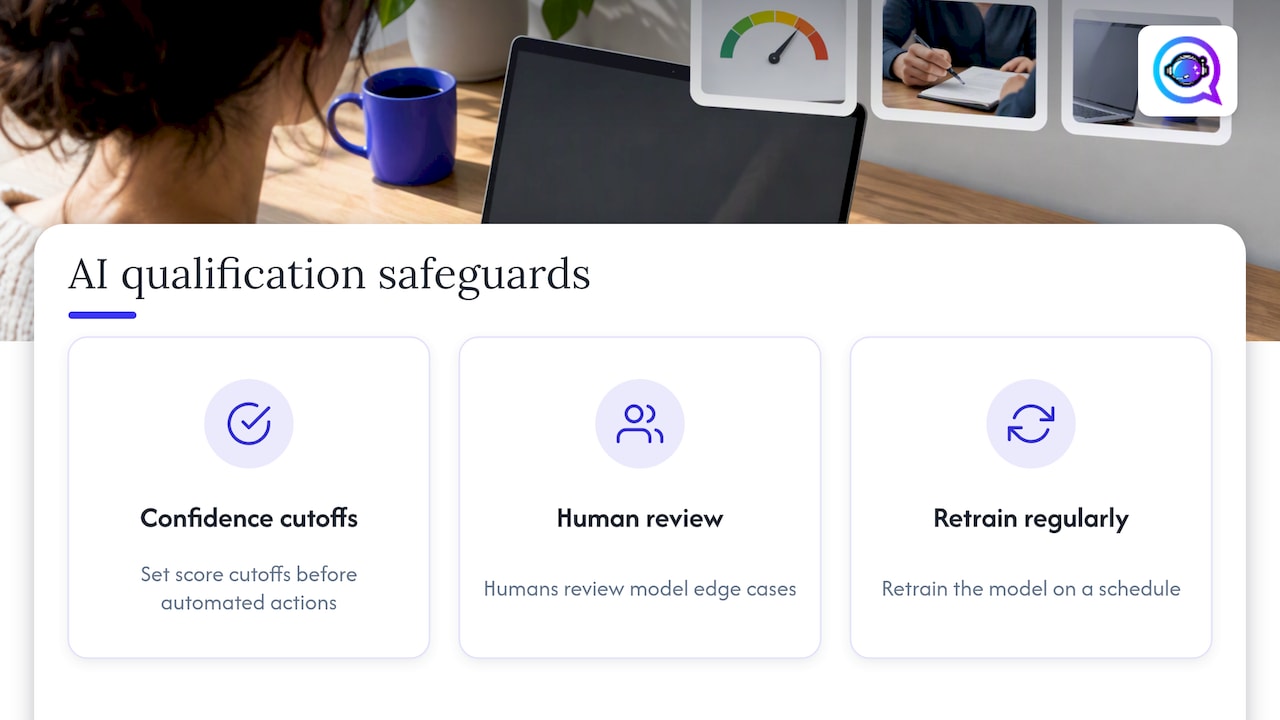
That said, automation has real limits. Poor data quality produces poor scores, over-automation can alienate leads who want a human, and models trained on biased historic data will repeat that bias. The fix is the same pattern throughout this playbook: set confidence thresholds, keep a human reviewing edge cases, and retrain on a regular cadence rather than letting the model run untouched for months.
Who benefits most, and what to measure
Service professionals with high lead volume and short decision windows tend to see the fastest results, because every hour of delay has an outsized cost.
Real estate agents often see higher appointment bookings when instant replies catch a buyer before they contact a competing agent.
Contractors use automated qualification to filter estimate requests by project size and timeline before a crew member calls back.
Therapists and other intake-heavy practices rely on automated scheduling to reduce no-shows and fill cancellations faster.
B2B teams running SDR-scale outbound use AI qualification to triage inbound from ABM campaigns without adding headcount.
A useful pilot success metric set: time-to-first-contact, qualification rate, and booking rate, each measured before and after automation goes live.
What we have learned building AI lead qualification

The biggest misconception we see is that AI qualification is a single switch you flip on. The systems that actually hold up train on a business’s own voice and conversation history rather than a generic script, because prospects notice the difference between a canned bot and a response that sounds like the business they contacted.
Enforcing qualification rules consistently, pulling signals from chat, forms, and voice, and writing clean data back into a CRM matters more than any single clever feature. A pilot checklist worth stealing: confirm your integrations first, start with one lead source, and review a sample of AI conversations weekly for the first month.
— Jamaal
How Astreaux fits into this playbook
We built our platform around the same principle this playbook follows: speed and personalization beat generic automation. Our conversational AI learns each business’s voice so replies to new leads sound like a real team member, not a script, and integrates with many apps to fit into whatever CRM or calendar a team already runs.
Real estate agents can use the platform to respond instantly and reduce no-shows through automated booking.
Contractors can qualify estimate requests and book site visits without manual back-and-forth; see our contractor-focused booking tools.
Therapists and counselors can automate intake and scheduling through our therapist intake automation tools.
If this playbook matches what your team needs, the next step is to see it running on your own leads: visit Astreaux AI to request a demo.
FAQ
What is AI lead qualification?
AI lead qualification uses automated scoring and conversational AI to evaluate incoming leads against criteria like budget, timeline, and intent, then routes the strongest ones to sales. It replaces manual review with real-time scoring, often within seconds of a lead submitting a form or message.
How do you use AI for lead qualification?
Teams typically connect an AI agent to their forms, chat, and email, let it ask qualifying questions and extract signals through natural language processing, then apply a scoring model with rule-based disqualifiers. The highest-scoring leads get auto-booked or routed to a rep, while uncertain ones go to human review.
What is the 30% rule in AI?
Readers researching a specific framework by this name should confirm the source defining it before applying it to a qualification pilot.
Are AI-qualified leads worth it?
Delayed contact substantially lowers the odds of converting an online lead, according to Harvard Business Review’s research on lead response times, which is the core problem AI qualification addresses by responding instantly. Results depend heavily on data quality and how conservatively a team sets its automation thresholds during a pilot.


