

Stop Black-Hole Leads: 5-Stage Handoff Process for Sales & Marketing
A clean lead handoff process is a five-stage, logged transaction: trigger, enrichment, routing, acceptance, first contact. Nothing counts until sales explicitly accepts the lead inside a time-boxed window and logs a first outreach attempt. The single highest-leverage fix for most teams is pairing that acceptance SLA with a mandatory context package, so no rep ever opens a lead record and has to guess who this person is or why they showed up.
TL;DR:
Most lead handoff failures stem from missing context, no clear acceptance step, and CRM mismatches, which slow down response times and reduce conversion.
Implementing a five-stage, logged process with explicit ownership and timestamps at trigger, enrichment, routing, acceptance, and first contact stages is essential for reliability.
Response times should be aligned with lead intent, with high-interest triggers contacted within minutes and lower-interest leads handled on the same day.
Tracking handoff leakage through acceptance rates and speed-to-contact helps identify system issues, requiring weekly reviews to prevent lost leads.
Automating acknowledgment, enrichment, and logging steps is crucial, with tools like Astreaux accelerating responsiveness and integrating with existing CRM workflows.
AstreauxKeep Every Lead MovingAstreaux helps service professionals respond instantly, personalize engagement, and streamline scheduling through conversational AI and app integrations.Book a call
What Is a Lead Handoff, and Why Do So Many Break Down?
A lead handoff is not just forwarding a name and phone number to a salesperson. It’s the structured transfer of a qualified prospect, along with the context that makes that prospect worth calling, from marketing’s ownership to sales’ ownership, with a documented moment where responsibility officially changes hands.
Most handoffs fail for three predictable reasons.
Missing context. The rep gets a name and email, not the pages viewed, the offer that converted, or the objection a chatbot already surfaced.
No SLA or acceptance step. The lead sits in a queue with no clock running and no one accountable for touching it.
CRM mismatches. Marketing automation platform and CRM disagree on lifecycle stage, creating what practitioners call a “black hole” handoff, where a lead technically exists in the system but nobody owns it.
Speed compounds all three problems, which is why understanding the impact of atendimento comercial nos EUA can help teams improve their sales responsiveness. Leads contacted within minutes convert at far higher rates than leads contacted hours later, which is why speed-to-contact is treated as a core lever rather than a nice-to-have metric.
The 5-Stage Handoff Process: Trigger, Enrichment, Routing, Acceptance, First Contact
Each stage needs an owner, a timestamp, and a defined “done” state. Vague ownership is how leads disappear.
Trigger. Marketing defines the event that starts the clock: a demo request, a pricing page visit paired with a form fill, or a lead score crossing threshold. Done means the trigger event is logged with a timestamp and reason code.
Enrichment. Marketing operations appends firmographic and behavioral data, company size, source campaign, pages viewed, before the record moves. Done means every required field is populated, not blank.
Routing. An automated rule assigns the lead based on territory, ideal customer profile fit, or rep capacity. Done means a specific rep or queue is assigned, not a generic team inbox.
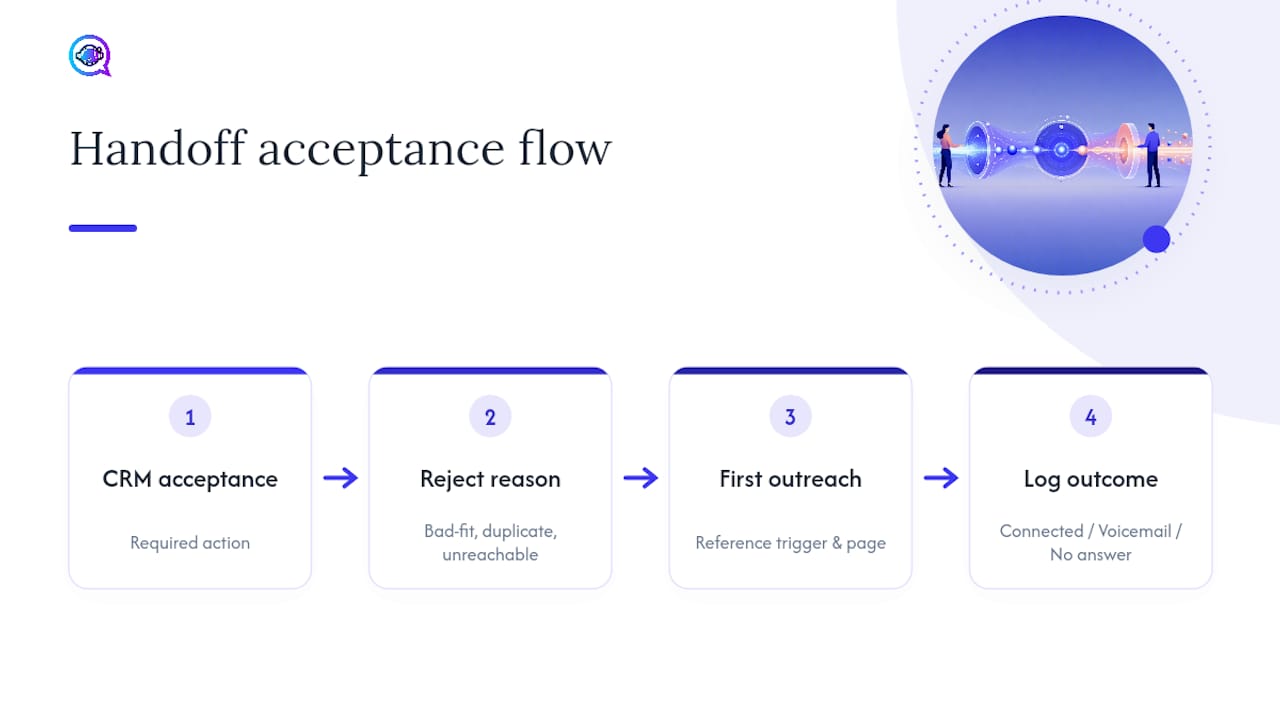
Acceptance. The assigned rep explicitly accepts or rejects the lead inside the CRM, with a reason code if rejected. A lead that’s been passed but never acknowledged has not completed a handoff at all.
First contact. The rep logs the outreach channel, timestamp, and disposition (connected, voicemail, no answer). Done means the activity trail shows an attempt, not just an intention.
Pro Tip: Attach one or two suggested opening lines to the lead record based on the trigger, referencing the exact offer or page that converted them. Reps hesitate less on the first call when marketing hands them a starting angle instead of a blank slate.
What Separates an MQL From an SQL?
The line between marketing qualified and sales qualified has to be written down, not felt out in a weekly meeting. An MQL typically combines fit signals (company size, industry, job title) with behavior signals (content downloads, pricing page visits, repeat site sessions). An SQL is an MQL that a human or a defined rule has confirmed matches budget, authority, need, and timeline closely enough for a rep to invest a phone call.
Building the threshold usually looks like this:
Assign point values to firmographic fit (title, company size, industry) and behavioral intent (demo request, pricing visit, email engagement).
Set a numeric cutoff, commonly somewhere in the 60 to 80 point range out of 100, above which a lead auto-routes to sales.
Expose the score breakdown to reps inside the CRM record, not just the total, so they can see whether a lead scored high on fit or on activity.
Review the threshold quarterly against actual close rates. A cutoff that looked right in January often needs adjusting once a full sales cycle of data comes back.
Reps trust a scoring model far more once they can see why a number landed where it did.
Routing, Enrichment, and CRM Requirements the Handoff Depends On
The handoff is only as reliable as the data sitting behind it. Marketing needs to hand sales more than a name.
Full activity trail: pages viewed, content downloaded, campaign source, and email engagement history.
Score breakdown showing fit points versus behavior points, not just a single composite number.
Trigger reason, logged as a discrete field, not buried in a notes box.
Deduplication check against existing contacts and open opportunities before routing.
Routing logic should account for territory, ideal customer profile match, and current rep capacity, with an overflow rule so leads never sit unassigned when a primary rep is at limit. Trigger reason and acceptance timestamp belong as their own fields on the lead or contact record, since a mandatory, time-stamped acceptance field is what lets the CRM automatically escalate an unactioned lead or recycle a rejected one back to marketing. Building this correctly the first time saves months of cleanup later; a step-by-step CRM integration setup is worth reviewing before you touch routing rules.
How Fast Should Sales Respond After a Handoff?
Response-time expectations should flex with lead intent, not apply as one blanket rule. A demo request or pricing inquiry warrants a response in minutes to an hour, while a lead who only downloaded a guide can tolerate a longer, same-day window, since response benchmarks vary meaningfully by conversion type.
Reasonable SLA bands vary with lead intent, with faster response expected for high-intent triggers and longer windows for lower-intent triggers.
Acceptance needs to be a discrete, required CRM action, not an assumption. If a rep rejects a lead, they select a documented reason (bad fit, duplicate, unreachable) so marketing can see the pattern instead of guessing. First outreach should reference the specific trigger, the page they viewed or the offer they claimed, and the outcome gets logged immediately, connected, voicemail, or no answer.
Pro Tip: Run a short A/B test on notification format during rollout, Slack alert versus in-CRM task versus email, to see which produces the fastest acceptance times for your team.
How Do You Know if Your Handoff Process Is Actually Working?
Handoff leakage is the percentage of qualified leads passed to sales that never receive a disposition, accepted or rejected, within the SLA window. Calculate it as leads with no disposition divided by total leads passed, per reporting period.
Track a short weekly dashboard instead of a sprawling one:
MQL to SQL acceptance rate.
Speed-to-first-contact, median and 90th percentile.
Lead-to-opportunity conversion rate.
Disposition breakdown (connected, no answer, rejected, disqualified).
Leakage is the honest number in this dashboard, since conversion rates alone can mask a broken handoff when a small batch of well-qualified leads still closes even as most of the queue goes untouched. Run a 15-minute weekly sync between marketing operations and sales leadership focused only on leakage spikes and rejection reasons. If rejections cluster around one lead source, fix targeting. If leakage spikes on Mondays, look at rep capacity.
Your 30-Day Rollout Plan for a New Handoff Process
You don’t need six months to fix this. A focused month gets most teams from ad hoc to operational.
Week 1: Document your MQL and SQL definitions, agree on the scoring model, and write the SLA bands for each trigger type.
Week 2: Build the routing and notification workflows in your CRM, including the required acceptance field and escalation rule for unactioned leads.
Week 3: Test notifications end to end, run a handful of dummy leads through the full five stages, and confirm timestamps log correctly.
Week 4: Train reps on the acceptance and disposition steps, launch for real, and schedule the recurring weekly leakage review.
For fastest impact, automate the acceptance step and the notification trigger first. Those two changes alone close most of the black-hole gap even before scoring and enrichment are fully refined. The most common rollout pitfall is skipping rep training on the disposition reasons. Without it, reps mark everything “unreachable” out of habit, and your leakage data becomes useless. Fix it by reviewing disposition entries in week one of launch and correcting misuse immediately. A practical automated follow-up guide covers the notification build in more detail if your team is starting from scratch.
Why Most Teams Underestimate How Fixable This Problem Is
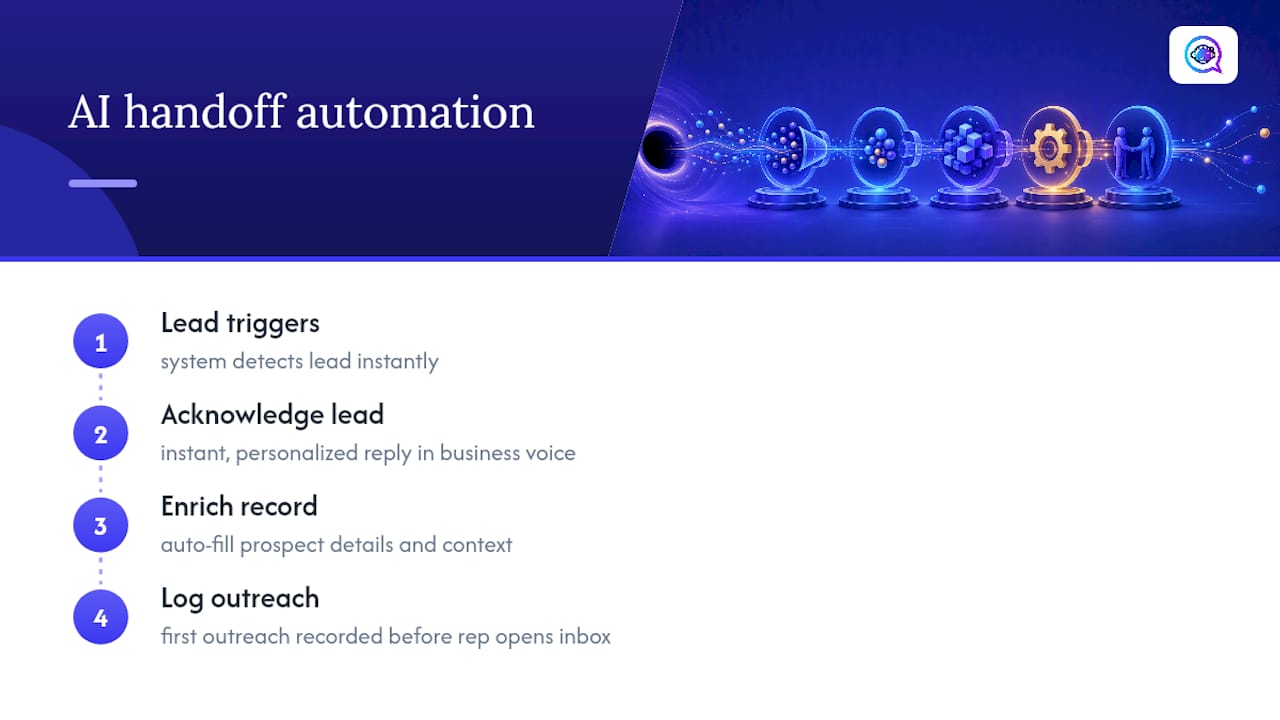
Most marketing and sales leaders treat a broken handoff as a communication problem, something a better weekly meeting will fix. It isn’t. It’s a systems problem, and AI-driven automation now handles the parts that used to require constant human vigilance: acknowledging a lead the moment it triggers, enriching the record automatically, and logging a first outreach attempt before a rep even opens their inbox.
For service professionals, real estate agents, contractors, and similar fields, that shift matters because the leads worth chasing often show up outside business hours. An instant, personalized reply that references what the prospect actually asked about, generated in the business’s own voice, tends to book more appointments and cut down no-shows . .
— Jamaal
Automate the Handoff Steps That Keep Falling Through
Astreaux is built for the exact gap most of this article covers: the minutes between a lead raising their hand and a human actually responding. Instead of a lead sitting in a queue waiting for someone to notice it, Astreaux sends an instant, personalized reply in the business’s own voice, logs the outreach automatically, and hands sales a record that already has context attached.

It accelerates the exact stages that break most manual handoffs: instant acknowledgment at the trigger stage, automatic enrichment pulled from the conversation itself, disposition logging so nothing sits unaccounted for, and escalation rules when a lead needs a human to step in. It integrates with CRMs and connects to more than 7,000 apps, so it slots into workflows real estate agents, contractors, and therapists already run, without ripping out existing tools. If you’re ready to see how automated acceptance and first contact would look inside your own pipeline, you can start a demo with Astreaux and watch a lead move through the process in real time.
Sources
FAQ
Can You Give an Example of Lead Scoring?
A common model assigns points for fit and behavior, with a numeric cutoff commonly somewhere in the 60 to 80 point range out of 100, above which a lead auto-routes to sales.
What Are the 7 Stages of a Sales Process?
Sales process stages typically run prospecting, qualifying, needs analysis, presentation, handling objections, closing, and follow-up, though this article’s five-stage handoff framework (trigger, enrichment, routing, acceptance, first contact) sits specifically inside the qualifying and early prospecting stages.
What Makes a Good Handoff Strategy?
A good handoff strategy pairs a documented MQL/SQL definition with a time-boxed acceptance SLA and a required context package, so no lead moves to sales without a logged trigger, enrichment data, and a clear owner.
What Does the Handoff Process Actually Involve?
It involves five logged stages, trigger, enrichment, routing, acceptance, and first contact, each with a timestamp and a defined outcome, so responsibility for a lead never sits ambiguous between marketing and sales.
How Does Automation Change the Handoff Process?
Automation platforms like Astreaux can send an instant reply at the trigger stage, auto-populate enrichment fields, and log first contact the moment a rep or the AI itself responds, closing the gap where most black-hole handoffs happen.