
AI Sales Automation for Service Professionals: Book More Meetings
AI sales automation turns inbound leads into booked meetings and a predictable pipeline by combining real-time lead capture, multichannel outreach, and next-best-action guidance in a single workflow. For service professionals, the fastest return comes from one focused pilot: automate your instant lead response and appointment booking before touching anything else. Gartner’s research on sales AI confirms that agentic AI, the kind that can plan and execute multi-step tasks autonomously, is the next major inflection point for sales teams.
Your next few days:
Audit your CRM data. Check for missing contact fields, duplicate records, and unlogged activities. Clean data is the foundation every AI model runs on.
Pick one pilot use case. Instant lead response or appointment booking delivers measurable results faster than any other starting point.
Schedule a demo with Astreaux. See how conversational AI handles lead replies, qualification, and booking in a live walk-through before committing to a full rollout.
What does AI sales automation actually do for your pipeline?
The term “sales automation” has been around since the first CRM, but AI-driven automation is a different category. Traditional tools execute rules you write. AI tools learn from behavioral signals, generate personalized outreach, and make decisions in real time. Here is what that looks like feature by feature.
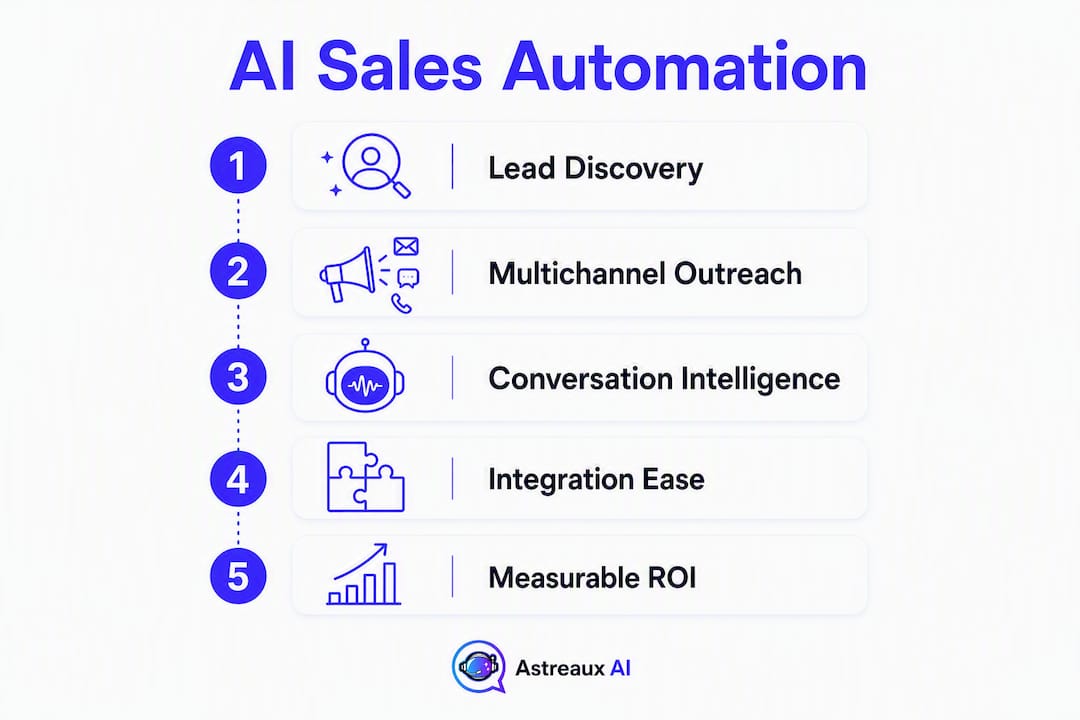
Lead discovery and enrichment
AI identifies high-intent prospects by reading behavioral signals: page visits, form completions, ad clicks, and email engagement. That data feeds a scoring model that ranks leads by purchase readiness, so your team works the warmest contacts first instead of dialing down a cold list. Salesforce’s guided selling framework describes this as surfacing next-best actions through CRM-integrated scoring, which shortens sales cycles and improves forecast accuracy.

Multichannel outreach and sequenced follow-ups
Once a lead is scored, the platform launches a coordinated sequence across email, SMS, and voice. Each message is personalized using the lead’s own data: their name, the service they inquired about, and the channel they responded to last. Sequences adapt in real time. If a prospect opens three emails but never clicks, the system shifts to SMS. If they book a call, the sequence pauses automatically.

AI agents that qualify and book
Highspot’s breakdown of AI use cases lists fifteen proven applications, including automated data entry, lead scoring, personalized messaging, conversation summarization, and dynamic content recommendation. The most impactful for service businesses is the AI agent that handles the full qualification-to-booking flow without rep involvement.
A typical automated flow looks like this: a new lead submits a contact form at 11 PM → the AI replies within seconds with a personalized message → it asks two qualifying questions via SMS → the lead selects a time from a live calendar → the appointment is confirmed and logged in the CRM, all before your team starts work the next morning.
Conversation intelligence and analytics
IBM’s overview of AI for sales highlights conversation intelligence as one of the clearest productivity gains: AI extracts call transcripts, flags objections, identifies buyer sentiment, and generates next-step summaries that coaches and reps can act on immediately. Paired with pipeline analytics, this gives managers a real-time view of where deals stall and which outreach sequences convert best.
How does AI-driven sales automation actually work under the hood?
Understanding the mechanics helps you evaluate whether a platform will fit your existing tech stack and data setup.
The flow runs in five stages:
Capture: Leads arrive from ads, web forms, chat widgets, or inbound calls.
Enrichment: The platform appends behavioral and firmographic data to each record.
Scoring: A machine learning model assigns a priority score based on historical conversion patterns.
Action: The system generates personalized outreach, triggers sequences, or routes the lead to a human rep with a recommended next step.
Feedback loop: Every reply, booking, and outcome updates the CRM and retrains the model over time.
What “agentic AI” means in practice
Gartner defines agentic AI as software that can perceive, decide, and act across integrations, creating plans and executing multi-step tasks without waiting for a human prompt at each stage. In sales, that means an agent can research a prospect, draft a personalized email, send it, monitor the reply, and update the CRM record, all autonomously. The practical rule: let agents handle research, qualification, and repetitive outreach; keep humans in the loop for negotiation and relationship-sensitive conversations. You can read more about this shift in why AI sales agents are replacing SDRs in 2026.
Integration requirements and the toggle tax
Every tool your reps switch between costs time. High-performing teams consolidate workflows into integrated platforms to limit context switching, a friction cost sometimes called the “toggle tax.” At minimum, your AI sales platform needs native or API-level connections to your CRM, email provider, calendar, and SMS or telephony system. Astreaux’s Zapier integration connects to over 7,000 apps, which means your existing stack stays intact.
Pro Tip: Before your pilot goes live, map every manual step a rep currently takes from lead arrival to booked meeting. Then fold each automation into your existing CRM workflow so activities are auto-logged and your pipeline data stays the single source of truth.
Watch for these technical risks:
Deliverability issues: Sending high volumes from a cold domain tanks inbox placement. Warm up sending infrastructure before full outreach.
Hallucinations: Generative AI can produce confident but incorrect personalization. Set guardrails and review templates before launch.
Training data leakage: Confirm that your contact data is not used to train public large language models. This is a contractual, not just a technical, requirement.
What measurable outcomes can you expect from sales automation tools?
Features matter less than the business results they produce. Here is what the research shows and how to track it.
Primary outcomes for service businesses:
Faster lead response times, often from hours to seconds
More meetings booked per lead, with less rep involvement
Higher conversion rates from lead to paying client
Reduced admin time, freeing reps for higher-value conversations
Improved forecast accuracy from cleaner pipeline data
Rain Sales Training’s survey data shows that sellers using AI report gains in productivity, personalization quality, and reduced manual work. The gains are not theoretical: teams that automate instant lead response see qualified meetings appear within days of going live.
KPIs to track from day one:
Lead response time (target: rapid response from inquiry)
Meetings booked per 100 leads
Conversion rate by lead source
Rep time reclaimed per week
Forecast accuracy (pipeline vs. actual close rate)
Snapshot ROI example: A real estate agent receives 40 new leads per month. Without automation, response time averages 4 hours and 20% convert to consultations. With AI instant response, response time drops to under 60 seconds and consultation bookings climb. The agent gains back roughly 6 hours of manual follow-up per week. For contractors and therapists, the same logic applies to estimate scheduling and intake booking respectively.
For industry-specific ROI benchmarks, AI lead generation tactics for realtors breaks down the numbers in detail.
How do you evaluate and choose an AI sales automation platform?
The market for AI sales software is crowded. This checklist cuts through the noise.
Evaluation checklist (prioritized):
Data readiness: Does your CRM have clean, structured contact records with required fields populated? No platform fixes bad data.
CRM integration: Does the tool connect natively to your CRM, or does it require a middleware workaround?
Calendar and booking: Can it read live availability and confirm appointments without rep involvement?
Deliverability infrastructure: Does the vendor manage domain warming, bounce handling, and unsubscribe compliance?
Security and compliance: Is data encrypted at rest and in transit? Are there audit logs? Can you prevent your data from training public models?
Support and training: What does onboarding look like? Is there a dedicated success manager or just documentation?
Pricing model: Is it per seat, per lead, or usage-based? Which model fits your pipeline volume and seasonality?
Questions to ask vendors in a demo:
How does your model handle leads that go cold after initial contact?
Can I see an audit log of every AI-generated action?
What happens if the AI misqualifies a lead?
What is your SLA for deliverability issues?
How is my contact data segregated from other customers’ training data?
Red flags to walk away from:
No native CRM workflow (everything routes through a separate dashboard)
Closed-data models with no audit trail
Deliverability managed entirely by the customer
No contract language on data privacy or LLM exposure
For a broader look at how platforms compare on features, top AI sales assistants for any industry is a useful reference.
On pricing: Per-seat models suit teams with stable headcount. Per-lead or usage-based pricing fits service businesses with seasonal pipelines, since you pay more in busy months and less in slow ones. Watch for setup fees, integration costs, and training time that inflate the true first-year cost.
How do you run a 6–10 week pilot that proves ROI?
The fastest path to a confident “go” decision is a narrow, well-measured pilot. Rain Sales Training recommends starting with high-friction, high-impact workflows rather than attempting full-stack automation at once.
Week | Focus | Key Actions |
|---|---|---|
1–2 | Prep and data clean | Dedupe CRM, fill required fields, define pilot use case |
3 | Integration | Connect CRM, calendar, email/SMS, and ad platforms |
4 | Test | Run internal test leads through the full flow end-to-end |
5–7 | Live pilot | Launch to a defined lead segment; monitor daily |
8 | Iterate | Review KPIs, adjust sequences and messaging |
10 | Scale decision | Compare pilot metrics to baseline; decide on full rollout |
Pilot checklist:
Define your single use case: instant lead response or appointment booking.
Identify the lead source (e.g., Facebook Ads, website form) for the pilot cohort.
Confirm CRM fields are clean for that contact segment.
Write and approve three to five message templates before launch.
Set your go/no-go thresholds: for example, a 15% lift in meetings booked or a 50% reduction in response time.
Assign one person to monitor the pilot daily for the first two weeks.
Salesforce’s Sales Cloud data shows that instant-response pilots commonly yield qualified meetings within days, with measurable ROI visible in a matter of weeks for focused deployments. That timeline makes a 10-week pilot a low-risk way to build internal confidence before scaling.
On change management: The biggest pilot failures come from reps who feel the AI is replacing them rather than supporting them. Share the pilot goals openly, show reps the time they will reclaim, and create a feedback loop where they can flag AI errors. A short playbook covering when to override the AI and how to escalate edge cases prevents most friction.
What data problems will derail your AI sales automation rollout?
Data quality is where most implementations quietly fail. Salesforce’s guided selling research is direct on this: without foundational data hygiene, AI tools propagate inaccurate insights and harm prospecting accuracy.
Common pitfalls:
Stale or duplicate CRM records that cause the AI to contact the same prospect twice
Missing key fields (phone, lead source, service interest) that break personalization logic
Unsegmented contact lists that send irrelevant messages to the wrong audience
Poor email domain reputation from previous bulk sends
Mitigation steps:
Run a deduplication pass before integration, not after
Define a canonical field set (first name, last name, phone, email, lead source, service type) and make them required in your CRM
Set an enrichment cadence: refresh contact data every 90 days
Check domain health with a deliverability tool before any outreach campaign
Governance checklist:
Assign a named data owner responsible for CRM hygiene
Confirm in your vendor contract that your data is segregated from other customers’ training sets
Require audit logs for every AI-generated action
Establish a review process for flagged or low-confidence AI outputs
Pro Tip: Run a small enrichment pass and a deliverability warmup on a 50-contact test cohort before your full pilot launch. If bounce rates exceed 5% or open rates are below 20%, pause and fix the list before scaling.
Rain Sales Training’s survey also flags tool overload and data accuracy concerns as the top barriers to AI adoption. Addressing both before launch dramatically improves your pilot success rate.
What does AI sales automation cost, and how fast will you see returns?
Pricing varies widely, but the model shapes are consistent across the market.
Pricing model shapes:
Per-seat subscription: A fixed monthly fee per user. Predictable cost, but you pay the same in slow months.
Per-lead or usage-based: You pay for what you use. Better for seasonal service businesses with variable lead volume.
Tiered flat rate: A base plan with feature gates at higher tiers. Common for SMB-focused platforms.
Budget line items to plan for:
Monthly platform subscription
One-time integration and setup fee (if applicable)
CRM data cleanup (internal time or a contractor)
Team training and onboarding time
Ongoing monitoring and optimization (roughly 2–4 hours per week in the first 90 days)
Time-to-value: Instant-response pilots yield first qualified meetings within days. Meaningful, measurable ROI typically appears in 6–12 weeks for focused pilots, based on Salesforce’s deployment data.
Simple ROI calculation:
If your average client is worth $3,000 and your current lead-to-close rate is 10%, you need 10 leads to close one deal. If AI automation lifts your conversion rate to 15%, you close 1.5 deals per 10 leads. On a 40-lead month, that is 2 additional closed deals, or $6,000 in added revenue, against a platform cost that is typically a fraction of that figure. The payback period for most service businesses running a focused pilot is well inside the first quarter.
Why Astreaux is built for service professionals
Astreaux is purpose-built for the workflows that matter most to real estate agents, contractors, therapists, and other service professionals: instant lead replies, appointment booking, and nurturing sequences that run without manual intervention.
Core capabilities that map directly to your needs:
Instant conversational AI replies: Astreaux responds to new leads in seconds, using a voice trained on your business’s own language and tone.
Appointment booking automation: Reads live calendar availability and confirms bookings without rep involvement.
Bulk SMS and drip campaigns: Reach your full contact list or a targeted segment with personalized messages at scale.
CRM and ad platform integrations: Connects to over 7,000 apps via Zapier, keeping your pipeline data in one place.
Voice training: Astreaux learns your business’s communication style so every automated message sounds like you, not a bot.
Analytics and pipeline reporting: Track lead response time, meetings booked, conversion rates, and sequence performance from a single dashboard.
Service-specific use cases:
Real estate agents: Automate responses to Zillow or Facebook Ad leads, qualify buyers and sellers, and book showings or consultations automatically. See how realtors can use AI to turn more leads into clients for specific workflows.
Contractors: Capture estimate requests, send instant confirmations, and schedule site visits without playing phone tag.
Therapists and counselors: Automate intake responses, send appointment reminders, and reduce no-shows with pre-visit SMS sequences.
Astreaux connects to over 7,000 apps, giving service professionals a single platform that handles lead capture, qualification, booking, and follow-up without requiring a separate tool for each step.
Astreaux’s integration count and conversational AI engine make it one of the most practical options for service businesses that need fast time-to-value without a complex enterprise implementation.
Key Takeaways
AI sales automation delivers the fastest ROI when you start with a single, high-impact use case, clean your CRM data first, and measure response time and meetings booked from day one.
Point | Details |
|---|---|
Start with one pilot use case | Instant lead response or appointment booking delivers measurable ROI in 6–12 weeks, as shown by Salesforce’s deployment data. |
Data hygiene comes first | Stale or duplicate CRM records cause AI to propagate bad insights; dedupe before integration. |
Evaluate on integrations and security | Prioritize native CRM connections, audit logs, and contract language on data privacy. |
Track the right KPIs | Lead response time, meetings booked per 100 leads, and rep time reclaimed are the clearest signals. |
Astreaux for service professionals | Astreaux automates instant replies, booking, and follow-up with over 7,000 app integrations for real estate agents, contractors, and therapists. |
The pilot approach that actually works for service businesses
The conventional advice on AI sales automation tends to focus on enterprise deployments: large CRMs, dedicated RevOps teams, and multi-quarter rollouts. Most service professionals do not have any of that, and they do not need it. The single most effective move is a narrow pilot on the one workflow that costs you the most right now: the gap between a lead arriving and a human responding.
Service businesses lose more revenue to slow follow-up than to any other single factor. A prospect who fills out a form at 9 PM and gets a reply at 10 AM the next morning has already moved on. Automating that first response, with a message that sounds like you and asks the right qualifying question, is where the ROI is immediate and undeniable. Everything else, the drip sequences, the conversation intelligence, the forecasting, builds on top of that foundation.
The teams that struggle with AI automation are almost always the ones who tried to do too much at once. Pick the bottleneck, automate it, measure it, and then expand. That sequence works whether you are a solo real estate agent or a contractor managing a team of five.
See Astreaux in action with a live demo
Service professionals who need faster lead response and more booked appointments without adding headcount get exactly that with Astreaux. The platform was built for your workflow: instant AI replies, live calendar booking, SMS follow-up, and CRM sync, all in one place.
In a demo, you will see a live walk-through of how Astreaux handles a new lead from first contact to booked appointment, including the voice training setup, integration options, and a sample ROI calculation based on your current lead volume. There is no generic slide deck; the demo is built around your use case.
Real estate agents can explore the AI lead outreach features for real estate, contractors can see the estimate booking automation, and therapists can review the intake automation workflow. Ready to see it live? Request your Astreaux demo and get a personalized walk-through within 24 hours.
Useful sources
The sources below are worth bookmarking if you want to go deeper on specific topics covered in this guide.
Source | What you will gain |
|---|---|
Gartner: The Role of AI in Sales | Analyst-level overview of agentic AI capabilities and where sales AI is heading |
Salesforce: AI Guided Selling | Practical explanation of CRM-integrated next-best-action and forecasting |
Salesforce Sales Cloud | Deployment benchmarks including time-to-value data for automation pilots |
Highspot: AI in Sales Examples | Fifteen concrete use cases with real-world application context |
Rain Sales Training: AI in the Sales Process | Survey data on productivity gains, adoption barriers, and governance recommendations |
IBM: AI for Sales | Technical overview of conversation intelligence and call summarization |
Academic perspective on how AI is reshaping go-to-market strategy |
FAQ
How do you use AI to automate sales?
Start by connecting an AI sales platform to your CRM, calendar, and outreach channels. The AI captures new leads, scores them by intent, sends personalized follow-up messages, and books appointments automatically. The fastest results come from automating instant lead response first, then expanding to full sequences.
Which AI platform works best for service professionals?
Astreaux is purpose-built for service businesses: it handles instant lead replies, appointment booking, SMS campaigns, and CRM integrations in one platform, with voice training so automated messages match your business’s tone.
Can AI actually replace manual sales follow-up?
AI handles the repetitive, time-sensitive parts of follow-up, including first response, qualification questions, and appointment confirmation, with no manual effort. Human reps stay focused on relationship-building and closing, where personal judgment matters most.
How long does it take to see ROI from sales automation tools?
Focused pilots on instant lead response typically produce qualified meetings within days. Measurable ROI, meaning a clear lift in conversion rate or meetings booked, is usually visible within 6–12 weeks, as shown by Salesforce’s deployment data.
What is the biggest risk when implementing AI in the sales process?
Poor data quality is the most common failure point. If your CRM has stale records, missing fields, or duplicate contacts, the AI will act on bad information and produce inaccurate outreach. Deduplicate and enrich your CRM data before any AI tool goes live.